


Product Description
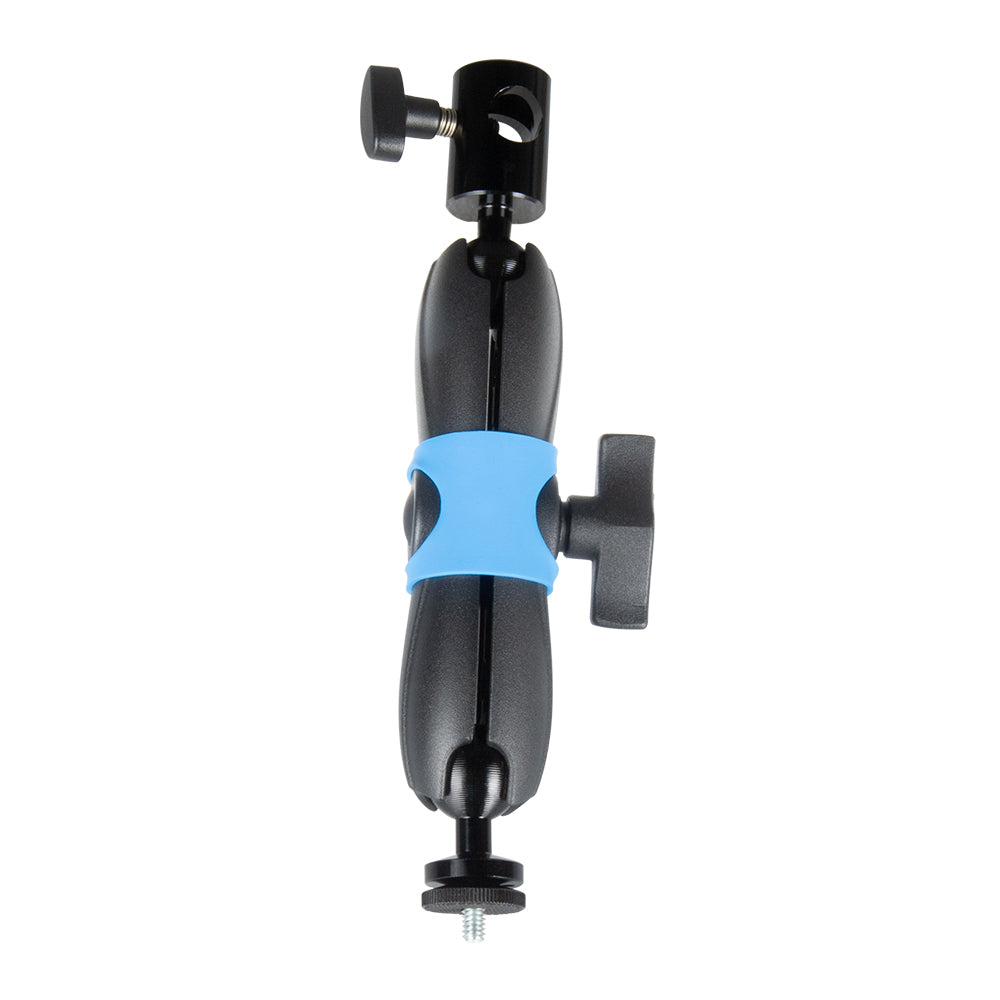
The KR VisionReach 16 Super Knuckle 15 cm (6 in) is the mount that brings a camera, light, sensor, or monitor out from a VisionGrid 16 frame to where it needs to look. It clamps to the 16 mm rail, gives you a fast knuckle arm for positioning, and ends in a standard ¼"-20 screw for your device.
The Super Knuckle is a double ball-and-socket arm - a ball joint at each end held by a single central knob. Loosen that one knob and both joints swing free for fast pan-and-tilt positioning; tighten it and the whole arm locks at once. At 15 cm (6 in) it's the middle length - more reach than the 8 cm (3 in), more stiffness and load margin than the 23 cm (9 in). Choose it when the 8 cm (3 in) can't quite reach but you don't need the longest arm.
Why VisionReach
A generic arm can hold a device for a while. VisionReach is built for setups that keep changing - you reposition the camera, swap the light, adjust the angle - without the arm slipping, twisting, or drifting out of position.
It's a known, reusable mounting path: a defined base that fits your frame, a defined arm class with a real load figure, and a standard device screw. When the layout changes, you adjust the arm instead of rebuilding the mount. If your camera needs a special interface, keep this as the standard mounting path and make only the device-side adapter plate custom - the rest stays reusable.
How It Mounts
This kit is the middle link of the chain - it connects your 16 mm VisionGrid rail to your device's ¼"-20 thread, base and arm included:
¼"-20 is the common camera/accessory thread. "Male" means this kit provides the screw; your device or adapter plate needs the matching female thread. If the image must stay level and can't twist on a single screw, add a locating pin or anti-rotation plate.
Super Knuckle or Omni?
Choose Super Knuckle when you want fast, freehand positioning - one knob frees both ball joints to glide to any angle, then locks them together, and it has the widest range of accessories. Choose Omni when you want more reach, higher load, or a repeatable angle you can return to exactly - that's what its rosette lock is for. They hold differently: Super Knuckle for quick, free movement, Omni for a locked, repeatable angle.
Reach and Load
This Super Knuckle reaches 15 cm (6 in) and carries up to 3 kg / 6.6 lb close to the clamp - a balanced reach - derating toward the tip. It is friction-held with a single knob - fast and freehand, but with no indexed angle return, so re-aim by eye after a bump; it is a positioning tool, not a production mount.
- Reach: 15 cm (6 in) nominal.
- Close-in working load: up to 3 kg / 6.6 lb.
- Best for: machine-vision cameras, lights, sensors, monitors, and accessory plates that need a mid-range reach.
Start with the shortest arm that reaches the target. The shorter Super Knuckle is cheaper, carries more load, and holds steadier - so reach for 15 cm (6 in) only when 8 cm (3 in) can't get to the target. The 3 kg figure is a close-in reference for the arm; usable load still depends on payload position, mounting angle, vibration, and cable pull. Secure the cable to the frame before judging stability - cable drag can shift a camera even within the load range. For work that must return to an exact, repeatable angle, the Omni's rosette lock is the better fit.
Best Applications
This Super Knuckle is at its best for fast, freehand camera and light positioning on a VisionGrid 16 bench, where quick repositioning matters more than a locked, repeatable angle.
- Mid-reach camera and light positioning on a VisionGrid 16 bench.
- Quick reconfiguration in integrator labs and prototype cells.
- Layouts where the target sits a little beyond a short arm's reach.
- Cable-managed setups within the arm's load range.
What's in the Kit
The kit ships as three parts - the sliding base, the 15 cm (6 in) Super Knuckle arm, and the ¼"-20 male device screw - and nothing device-specific.
- VisionReach 16 sliding base for the 16 mm VisionGrid rail.
- Super Knuckle 15 cm (6 in) arm.
- ¼"-20 male device screw.
Not included unless bundled: the camera, lens, light, sensor, monitor, or controller; a camera-specific adapter plate; the VisionGrid frame itself; and cable strain-relief hardware.
Before You Order
Before ordering, confirm four things: a 16 mm VisionGrid rail, a ¼"-20 female device thread, payload and cable pull suited to a 15 cm (6 in) reach, and a reviewed path if the setup is vibration-prone or production-bound.
- Confirm your frame is a 16 mm VisionGrid rail (not 22 mm tube, 35 mm post, or extrusion).
- Your device needs a ¼"-20 female thread, or an adapter plate that gives it one.
- Check that payload weight, center of gravity, and cable pull suit the 15 cm (6 in) reach.
- If the setup is vibration-prone, overhead, in a moving-machine area, or headed for production, talk to us about a reviewed mounting path first.
Frequently Asked Questions
Will this fit my frame?
It fits the 16 mm VisionGrid rail. For a 22 mm VisionGrid Pro tube use VisionReach 22; for a 35 mm post use VisionFrame 35; for 3030/4040 extrusion use SightLink E3040.
What else do I need for my camera?
The kit ends at a ¼"-20 male screw. Your camera (or an adapter plate) needs a matching ¼"-20 female thread. If the image must stay level, add a locating pin or anti-rotation plate.
Super Knuckle or Omni for a camera?
Super Knuckle is faster and freer to adjust - great for trials and frequent repositioning. The Omni's rosettes lock to an exact, repeatable angle, so it's the pick when a camera must stay at one precise angle. Reposition often → Super Knuckle; set an exact angle and return to it → Omni.
Should I pick 8, 15, or 23 cm?
Start at 8 cm (3 in) - it's the cheapest, strongest, and steadiest. Choose 15 cm (6 in) for a balanced reach when 8 cm (3 in) falls short, or 23 cm (9 in) only when you need the extra reach and can accept a lighter payload.
Can I use it for factory production?
It's built for lab benches, VisionGrid 16 setups, and prototype cells. For factory release, vibration, or strict image-position tolerance, choose a reviewed mounting path instead.