

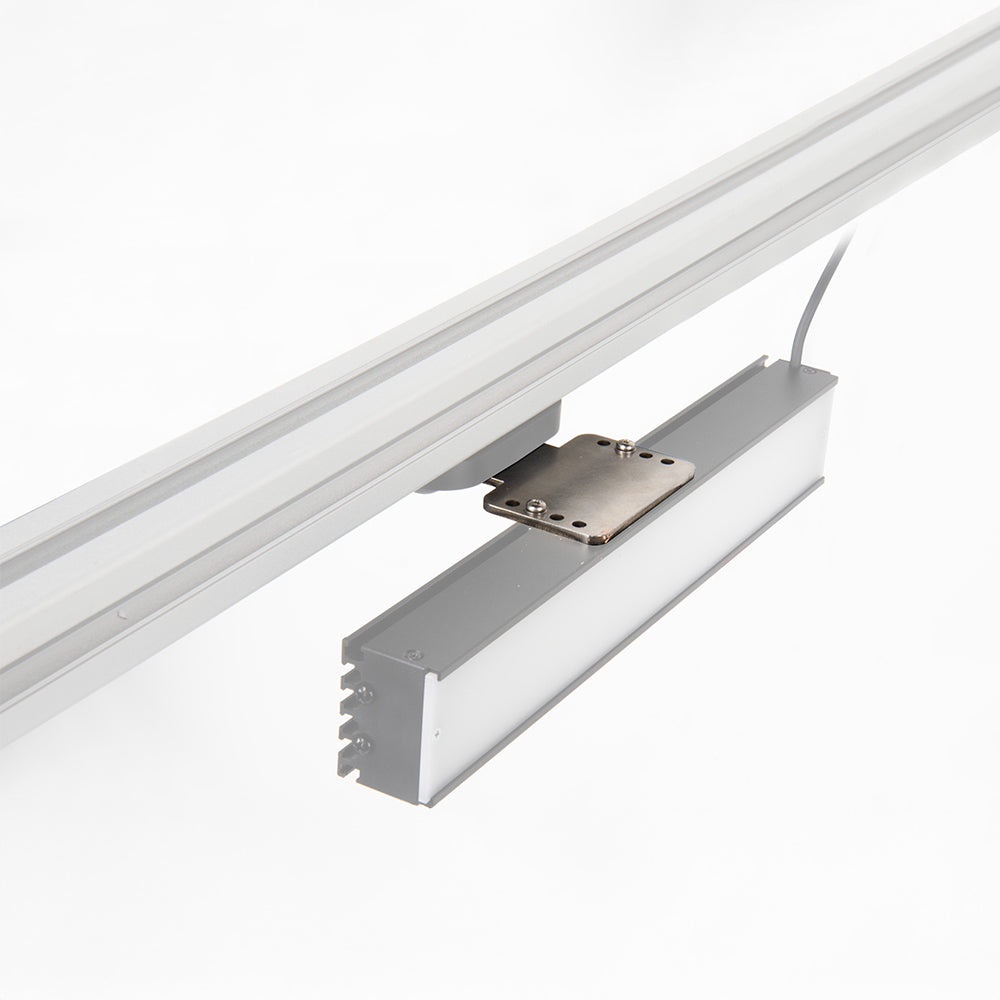
Product Description
The KR VisionHolder Rosette Bar Light Mount holds a rectangular machine-vision bar light on an indexed rosette connection - so the raking angle you tuned for contrast is a locked tooth position, not a friction setting that drifts. It is a T-shaped stainless bracket with a rosette foot on one face and M3 mounting hardware for the light.
Bar lights live and die by their angle: a few degrees decide whether a scratch pops or disappears, whether a glare band lands in the image or outside it. The rosette foot bolts onto any rosette output in the SightLink system - the extrusion base node, either face of the 90° connector, or either end of a rosette extension arm - and its teeth index the angle so it survives service and comes back after re-assembly.
Your bar light fastens to the bracket with the included stainless M3 hardware - socket or external-hex screws, locked with washers and nuts.
Why VisionHolder
In machine vision, the light angle is half the inspection - and no light is more angle-sensitive than a bar light doing low-angle or raking work. VisionHolder puts it on the same indexed rosette chain as the camera, so the angle is repeatable by design.
VisionHolder is the payload side of the SightLink rosette mount system: the camera plate, the ring light mounts, and this bar light mount all share the same rosette foot. A bar light can take over any position a camera was using, two payloads can run off the two ends of one extrusion-mounted arm, and every one of them locks to a tooth position that survives loosen-and-retighten. You stop re-tuning the scene every time someone touches the frame.
How It Mounts
This mount is the last link before the light - its rosette foot lands on any rosette output in the SightLink chain, and your bar light bolts to the bracket with the included M3 hardware:
The bracket ships with the richest hardware set in the light-mount family - stainless M3 socket screws, external-hex screws, washers, and lock nuts - so common bar-light bolt patterns fasten without a trip to the hardware drawer. Check your light's mounting-hole spacing before ordering.
Bar or Ring?
Choose the Bar Light Mount for rectangular lights - bar and linear designs doing directional, low-angle, or raking illumination. Choose a Ring Light Mount (40-120 mm plates) for circular ring lights working around the lens axis.
Both families carry the same rosette foot, so the choice is only about the light's shape - the chain underneath, and the indexed-angle behavior, are identical.
Stainless, Ready for the Floor
Body and hardware are stainless steel - no coating to chip into the work area, nothing to rust in a damp corner of the shop, and a surface that wipes clean.
- Stainless bracket and stainless hardware - one material story, down to the lock nuts.
- Raw stainless finish - bare metal, easy to wipe down.
- Edges lightly broken - deburred for safe handling during installs and service.
Best Applications
Use the Bar Light Mount wherever a directional light's angle has to be exact - and stay exact:
- Low-angle and raking illumination for scratch, dent, and texture inspection.
- Directional bar lighting along an edge, seam, or weld line on an extrusion cell.
- Production stations where the light angle must survive cleaning and lamp swaps.
- Indexed camera-plus-light pairs on one rosette chain - light off one arm end, camera off the other.
- Repeatable A/B lighting trials: step the angle by teeth, note the position, return to it.
What's in the Box
The box holds the stainless bar light bracket and its full stainless M3 hardware set - the last link before your light.
- VisionHolder Rosette Bar Light Mount (stainless steel T-bracket).
- Stainless M3 hardware set: socket screws, external-hex screws, washers, and lock nuts.
Not included: the bar light itself, and the rosette chain it lands on - the SightLink base node, 90° connector, and extension arms are sold separately, as is the extrusion frame.
Before You Order
Before ordering, confirm three things: your bar light's mounting-hole spacing, a rosette output on your frame for the foot to land on, and a short support path from frame to light.
- Check the light's mounting-hole spacing and screw size against the bracket's mounting pattern - M3 hardware is included.
- The foot needs a rosette to bolt to - a SightLink base node on the extrusion, a 90° connector, or an extension-arm end.
- Keep the light close to the frame; a long bar light on a long chain is a lever, and short chains hold angles best.
- Plan static, indoor mounting on the frame - and strain-relieve the light's cable near the light so it can't tug the angle.
Frequently Asked Questions
Which bar lights fit?
Rectangular machine-vision bar lights that fasten with M3 screws - the bracket ships with stainless socket screws, external-hex screws, washers, and lock nuts. Check your light's mounting-hole spacing before ordering.
Does it fit my existing SightLink rosette parts?
Yes. The foot carries the same indexed rosette pattern as the VisionHolder camera plate, so it bolts onto any rosette output in the family - the extrusion base node, either face of the 90° connector, or either end of a rosette extension arm.
Why an indexed rosette instead of a ball joint?
Teeth, not friction. A ball joint holds an angle until something nudges it; rosette teeth lock into a set position and return to it after every loosen-and-retighten. For raking light - where two degrees decide whether a defect shows - that repeatability is the whole product.
Can I swap it with a camera plate on the same arm?
Yes - camera plate, ring light mounts, and bar light mount all share the same rosette foot, so payloads swap on the same chain without rebuilding it. One extrusion-mounted arm can run a light off one end and a camera off the other.
What about the light's cable?
Anchor it. Secure the cable to the arm or frame close to the light so its weight and movement can't load the joint - cable pull is the classic way a "set" light finds a new angle overnight.
My light is a ring, not a bar - which mount?
Use the VisionHolder Rosette Ring Light Mounts: five plate sizes from 40 to 120 mm cover compact coaxial rings up to the largest ring bodies, all with the same rosette foot as this bracket.