

Product Description
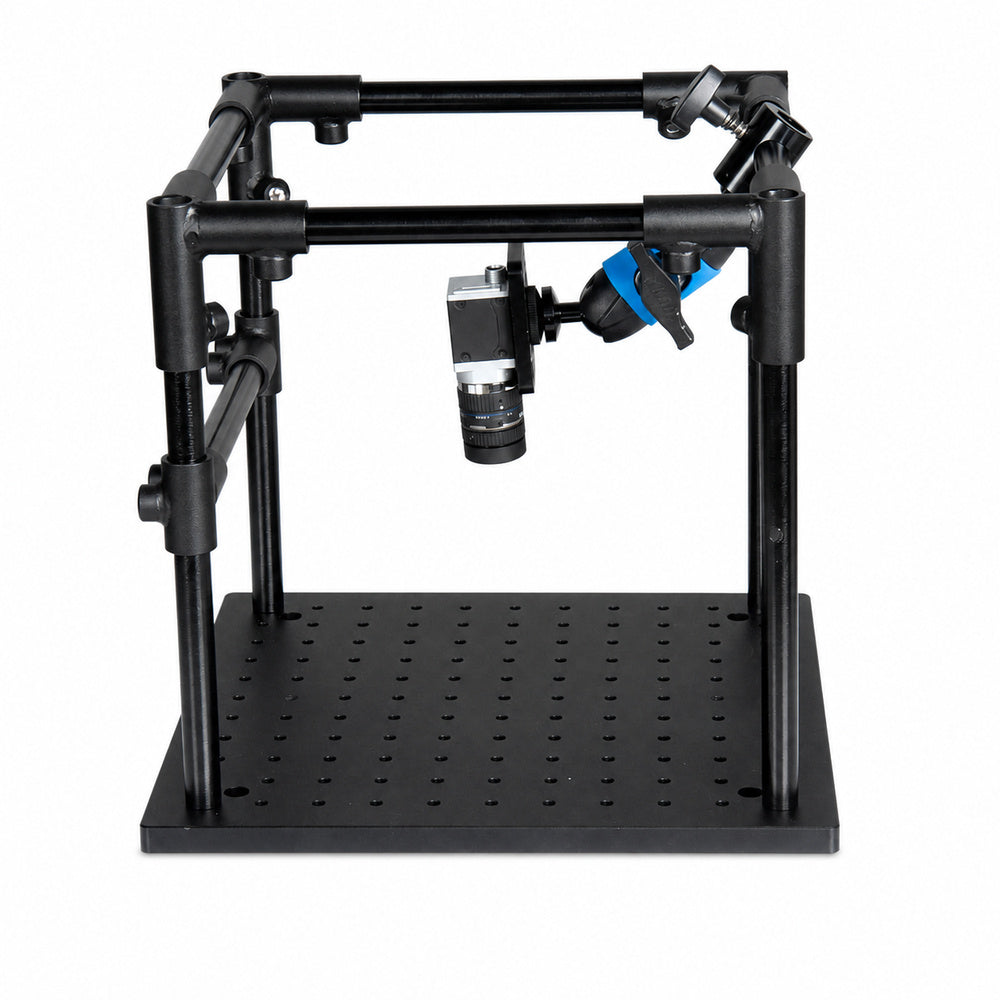
The KR VisionGrid 16 Compact is the fastest way to stand up a tidy machine-vision test bench on a benchtop. It pairs a 30 x 30 cm optical breadboard with a 16 mm frame structure, giving you a repeatable grid to position a camera, a light, and a sample without improvising brackets or drilling one-off plates.
It is built for the moment before a layout is locked: when you need to get a camera looking at a part, prove the inspection works, and show it to a customer. When the angle, working distance, or lighting needs to change, you move a module instead of remaking a mount. That makes it a strong demo and proof-of-concept platform for integrators who want to test fast and reconfigure freely, and a clean, organized base for lab and R&D benches.
VisionGrid is a foundation you build on. The frame and grid give you the structure; you add the camera, light, reach arm, and device plate that match your application - as separate modules or as a bundle.
Why Integrators Choose VisionGrid
A one-off bracket holds exactly one setup. VisionGrid is built for the setups that keep changing - different camera, different light, different part, different angle - which is exactly what a demo or pilot cell goes through before anyone commits to a final design.
- Stand up a working camera-and-light setup in minutes, not a fabrication cycle.
- Reconfigure by moving or swapping modules - no drilling, stacking, or remaking brackets.
- Keep the 30 x 30 cm grid organized for samples, cables, and small modules.
- Reuse the same frame across projects instead of building a new rig each time.
- Carry a credible, repeatable demo cell to a customer instead of a taped-together bench.
Custom fabrication still wins once the production geometry is locked and you need a dedicated engineered mount. VisionGrid is for everything before that point - layout trials, repeatable test benches, demo cells, and pre-release setups where the camera, light, lens, or sample handling can still change.
Where It Fits
VisionGrid 16 Compact is the compact-platform layer of the KUPO Robotics system. It gives you a structured frame and a defined working zone; the reach arms and device plates stay modular so you can match each build to its payload and working distance.
A typical setup builds up like this:
Use the Compact when the work is benchtop and the footprint matters. Step up to a 40 x 40 cm board or the 22 mm Pro frame when the sample area, camera distance, or number of modules outgrows it.
Frame, Mounts, and Working Zone
The frame is a 30 x 30 cm optical breadboard on a 16 mm compact rail with a removable sliding crossbar - a clean parent structure for adjustable camera, light, sensor, and monitor mounting. Exact mount positions depend on your final layout and the VisionReach 16 arms you choose.
- Platform format: 30 x 30 cm optical breadboard.
- Frame structure: 16 mm compact rail / mini portal with a removable sliding crossbar.
- Compatible mounts: VisionReach 16 arms, sized to your payload, working distance, and available frame space.
- Best at: modular lab setups, alignment, inspection, and quick reconfiguration.
Load and Stability
The 30 x 30 cm board is a light-duty benchtop base, and usable load depends on the mounts you choose, where the payload sits, and how cables are routed. In practice the Compact is sized for machine-vision cameras, small lights, sensors, monitors, and lightweight accessory plates carried on VisionReach 16 arms.
For the sharpest images, keep arms short, payloads centered, and cables managed. Long arms, heavy payloads, side load, vibration, and loose cables all reduce stability. Before using it for continuous factory duty, vibration-prone lines, overhead mounting, public-space installs, or a moving-machine area, confirm the mounting path with us - that is where the Factory Line is the right tool.
Best Applications
VisionGrid earns its place in the still-changing phase of a build - where the camera, light, and sample are still moving - from positioning trials and proof-of-concept cells to customer demos and repeatable lab benches.
- Camera and light positioning trials for machine-vision inspection.
- Lens, filter, and small-sample inspection tests.
- Benchtop proof-of-concept and pilot inspection cells.
- Customer demos and expo setups that show the modular KUPO Robotics system.
- Cable-managed lab benches that need repeatable physical layout.
What's in the Kit
The kit delivers the complete VisionGrid structure: the 30 x 30 cm optical breadboard, the 16 mm frame, anchors, and assembly hardware - everything you need for the frame and working grid.
You choose the application modules separately (or as a bundle): the camera, lens, light, sensor, monitor, controller, VisionReach arm, and any device-specific adapter plate or cable strain relief. This is deliberate - it lets you match each build to its exact payload and working distance instead of paying for parts you won't use.
Before You Order
A quick check keeps your first build right - confirm the workspace footprint, your device's mount path, the VisionReach 16 arm sizing, and whether the setup is headed somewhere the Factory Line should handle.
- Confirm the 30 x 30 cm platform suits your workspace and sample size.
- Check that your camera, light, sensor, or monitor has a compatible mount path (1/4"-20 or an adapter plate).
- Make sure the payload weight, center of gravity, and cable routing suit a VisionReach 16 arm.
- If the setup is vibration-prone, overhead, in a moving-machine area, a public-space install, or headed for production, talk to us about the Factory Line first.
Frequently Asked Questions
Is the KR VisionGrid 16 Compact a complete inspection system?
It's the platform you build one on. The kit gives you the 30 x 30 cm structure and working grid; cameras, lights, sensors, VisionReach arms, and device plates are chosen separately so the setup fits your application - or bundled if you'd rather buy it complete.
Should I choose the 30 x 30 cm Compact or size up?
Choose the Compact when the work is benchtop and space is tight. If the sample area, camera distance, or module count needs more room, move up to a 40 x 40 cm board or the 22 mm Pro frame.
Which mounts fit this frame?
VisionReach 16 arms. Pick the arm length and adjustment style after confirming payload weight, working distance, cable pull, and whether the image angle needs to stay fixed.
How many cameras or lights can it hold?
Plan around your working distance, sample access, cable paths, and arm reach rather than a fixed number. For most compact inspection trials, one camera and one light is the natural starting point, with room to add modules as the layout firms up.
When should I move beyond VisionGrid?
Step up to VisionFrame 35 or a reviewed Factory Line path when you need larger geometry, higher stiffness, vibration tolerance, or a permanent machine-frame installation.